







Defence and security drive new legal challenges
by glória paiva
Against a backdrop of rising geopolitical tensions, increased European investment and accelerating technological change, the defence and security sectors are creating new business opportunities while posing increasingly complex legal challenges for companies. From the drone and military equipment industries to dual-use technologies, cybersecurity and artificial intelligence, the sector’s expansion requires specialist legal advice capable of anticipating risks and navigating an ever-evolving regulatory landscape.
This was the main message to emerge from a discussion on security and defence organised by Antas da Cunha Ecija on 3 November at the Sociedade de Geografia in Lisbon. In an exclusive report, Iberian Lawyer brings together insights from the event, which gathered representatives from the law firm and the industry to discuss the sector’s transformation, the opportunities available to businesses and the role of law in this market.
The session opened with remarks from Fernando Antas da Cunha, the firm’s managing partner, who discussed the launch of its new Security and Defence practice, an initiative reflecting the growing importance of the sector.
“It is a context marked by the strengthening of European strategic autonomy, growing investment in defence and security, the increasing relevance of dual-use technologies and the rise in regulatory requirements that are profoundly transforming the sector”, said Fernando Antas da Cunha. “Companies linked to the defence industry, critical technologies, cybersecurity and strategic infrastructure face major challenges today, namely in public procurement, import/export controls, compliance, protection of classified information and intellectual property, risk management, M&A and investment, among others”, he added.
Antas da Cunha Ecija recently announced the expansion of its activities into the security and defence sectors (click to read), through a new practice coordinated by partner Paulo Sande, with the support of colonel Luís Manuel Brás Bernardino, who joined the project as an international security consultant. “We want to speak to companies in their own language,” said Paulo Sande in an interview with Iberian Lawyer. According to the lawyer, the team is expected to comprise around ten professionals from different areas of expertise, with the aim of providing an integrated approach and helping companies navigate a rapidly changing market.
A period of revolution
The central role of security in the lives of societies, individuals and businesses was also at the heart of Luís Bernardino’s contribution. A colonel in the Portuguese Army Reserve, with experience in missions for the UN, the EU and NATO, the consultant described the current period as a revolution in the fields of security and defence, whose effects will be felt by companies, organisations and countries in the years ahead.
“Security is like oxygen: we only realise it is missing when we no longer have it”, he said. Bernardino argued that investment in this area must be continuous and focused on the long term, highlighting the need for companies to develop organisational resilience – the ability to recover from crises and anticipate future risks.
The consultant also emphasised the increasingly close relationship between security and economic development. In his view, there can be no digital transformation without security, nor can security be ensured without understanding technological change. Current conflicts also demonstrate the importance of investing in people’s skills and leadership. “Complex problems require integrated solutions that bring together different skills, companies and synergies”, he said.
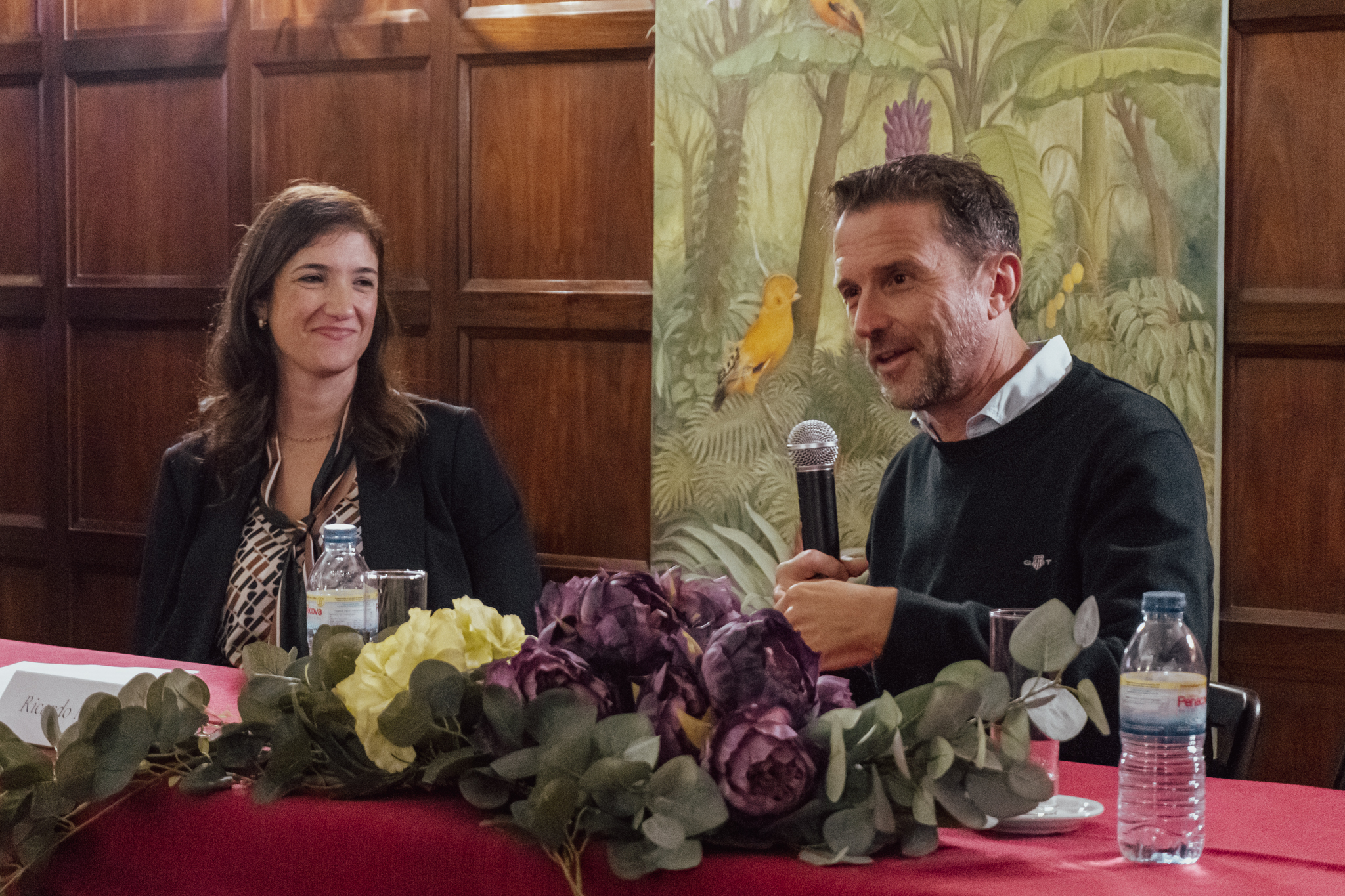
The impact of these changes on industry was illustrated by Ricardo Mendes, CEO of Tekever, in conversation with Priscila Santos, counsel at Antas da Cunha Ecija. Founded in Portugal in 2001 by computer engineers, Tekever began as a software development start-up and has since evolved into a technology group specialising in unmanned aerial systems, AI-powered maritime and land surveillance, and space technologies. The company was selected by the UK Ministry of Defence to supply the CORVUS surveillance programme for the British Army.
For Mendes, Tekever’s experience shows how technology companies can play a significant role in the European defence industry. The CEO explained that the company’s entry into the market was driven by the war in Ukraine, following a request from the UK Home Office that led to the development of solutions for long-range missions and surveillance beyond national borders.
Mendes believes the future of the industry will be shaped by companies with software expertise rather than traditional hardware manufacturers. In this context, he identified Tekever’s Portuguese origins as a competitive advantage in international markets. “As a country without the geopolitical weight of powers such as Germany, France or Italy, Portugal is often perceived as a more neutral partner”, he said.
Mendes also called for closer cooperation between technology companies and law firms, which he believes should act as legal infrastructure partners. In his view, “technological developments will create new opportunities in areas such as AI, genetics and biotechnology, many of which are still difficult to anticipate”.
Multidisciplinary legal challenges
In the final part of the event, three Antas da Cunha Ecija lawyers outlined the main legal challenges associated with the expansion of the defence and security sectors, drawing on their respective areas of expertise.
Gonçalo Guimarães, an associate in the EU and Competition practice, discussed the growing integration of defence into the dynamics of the European market. For a long time, he explained, the sector was seen as an activity removed from traditional market rules and mechanisms. That has changed: “defence is now at the centre of investment decisions, competition policy and public procurement,” he said. The pandemic, the war in Ukraine, the energy crisis and conflicts in the Middle East have exposed vulnerabilities and demonstrated that European security can no longer rely on the same assumptions as in the past.
Jane Kirby, a partner in the Public Law, Planning, Environment and Energy practice, outlined the specific features of public procurement in the defence and security sectors. Although these contracts are generally subject to competition principles and the rules applicable to contracting authorities, a special regime also exists under Law No. 104/2011, which covers certain procurements in this field. “The specific nature of this regime is justified by the goods, services and technologies involved, which may have direct implications for security and the national interest,” she explained. Contracts involving drones, military equipment and other sensitive materials may therefore benefit from a specific legal framework, without this amounting to a general exemption from competition rules.
Finally, Carolina Meireles, counsel in the Commercial, Corporate and M&A practice, highlighted the challenges involved in setting up and operating companies in the defence and security sectors. “These activities are subject to specific regulatory requirements, which may include security clearances and scrutiny of both direct and indirect shareholdings,” she noted.
The lawyer also drew attention to foreign direct investment (FDI) screening mechanisms, which are particularly stringent in sectors considered sensitive to national security, as well as the rules governing transfers of stakes in companies involved in the arms industry. In this context, she stressed the importance of legal advice from the outset, covering company formation, investment structuring and the negotiation of commercial agreements.
The event highlighted that the expansion of the defence and security industry depends not only on investment, innovation and technological capabilities. Regulatory adaptation, risk management and coordination across different areas of legal expertise are also central to companies seeking to enter or strengthen their position in this market.
Pictured above: Paulo Sande, Fernando Antas da Cunha, Luís Bernardino
Pictured below: Priscila Santos, Ricardo Mendes